

What ATEC will and won’t do
On 26 November 2025 the Australian government introduced the Universities Accord (Australian Tertiary Education Commission) Bill 2025 into the parliament.
The legislation specifies the following objectives for ATEC:
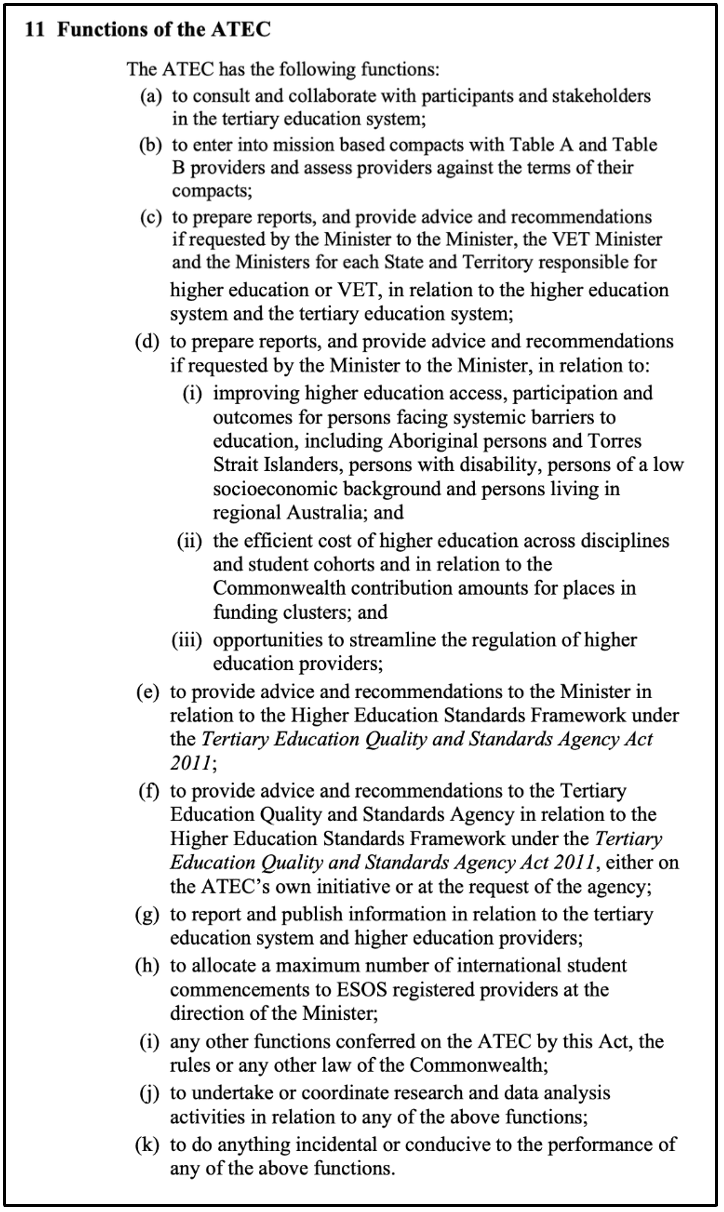
As Secretary of the Department of Education, Tony Cook PSM, explained in his appearance at Senate Estimates on Thursday 4 December 2025 “the ATEC actually doesn’t have a role around policy. The ATEC has a role around advice and about particular functions in relation to that advice. The Department still has advice (responsibilities, through) the Higher Education, Research and International branch.”

Cook went on to draw comparisons between the way ATEC will work, with all of its staff except its three Commissioners being employees of the Department of Education (or secondees from other government agencies), with the way that Jobs and Skills Australia’s staff (except its Commissioners) are all employees of the Department of Employment and Workplace Relations.
What was not well canvassed in the Senate Estimates hearings were the following issues:
- whether or not ATEC will be able to give the Minister for Education advice on student contributions for domestic undergraduate students at Table A (publicly-funded) universities
- the fact that all universities will have to have ‘mission based’ funding compacts with ATEC, and if they do not meet the required levels of performance in the compact, ATEC will have the powers to suspend or cancel the compact – but because all universities will need to have a compact – universities could end up with the same default compact in place as the one ATEC has just cancelled/suspended
- how TAFE Institutes which receive Commonwealth Supported Places funding will engage with/be accountable to ATEC given the ‘mission based funding compacts’ apply only to Table A and B providers, and
- the fact that the legislation does not allow ATEC to give advice to the Minister or produce reports (except for an annual report on the “State of the Tertiary Education System’, a Statement of Strategic Priorities, and an annual workplan) unless specifically requested by the Minister.
I agree with Prof. Andrew Norton that the legislation clearly does not specify that ATEC can give advice on student contributions – but I think what Norton describes as ATEC only being able to”indirectly and impliedly advise” on student contributions, potentially underplays the fact that their advice will make it very obvious what they think student contributions should be.
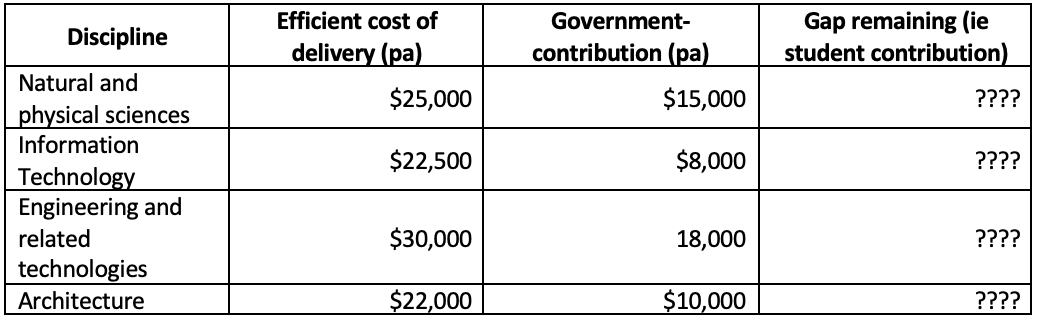
That is because ATEC’s objectives specifically include, Section 11(d)(ii), preparing advice on “the efficient cost of higher education across disciplines and student cohorts and in relation to the Commonwealth contribution amounts for places and funding clusters.”
So when the Minister asks for funding advice – ATEC will have to give advice on (a) what it costs to teach different disciplines, and (b) the amount of funding ATEC thinks the government should contribute. It’s obvious that the student contribution must fill the gap. Here’s a hypothetical for a few fields of education:
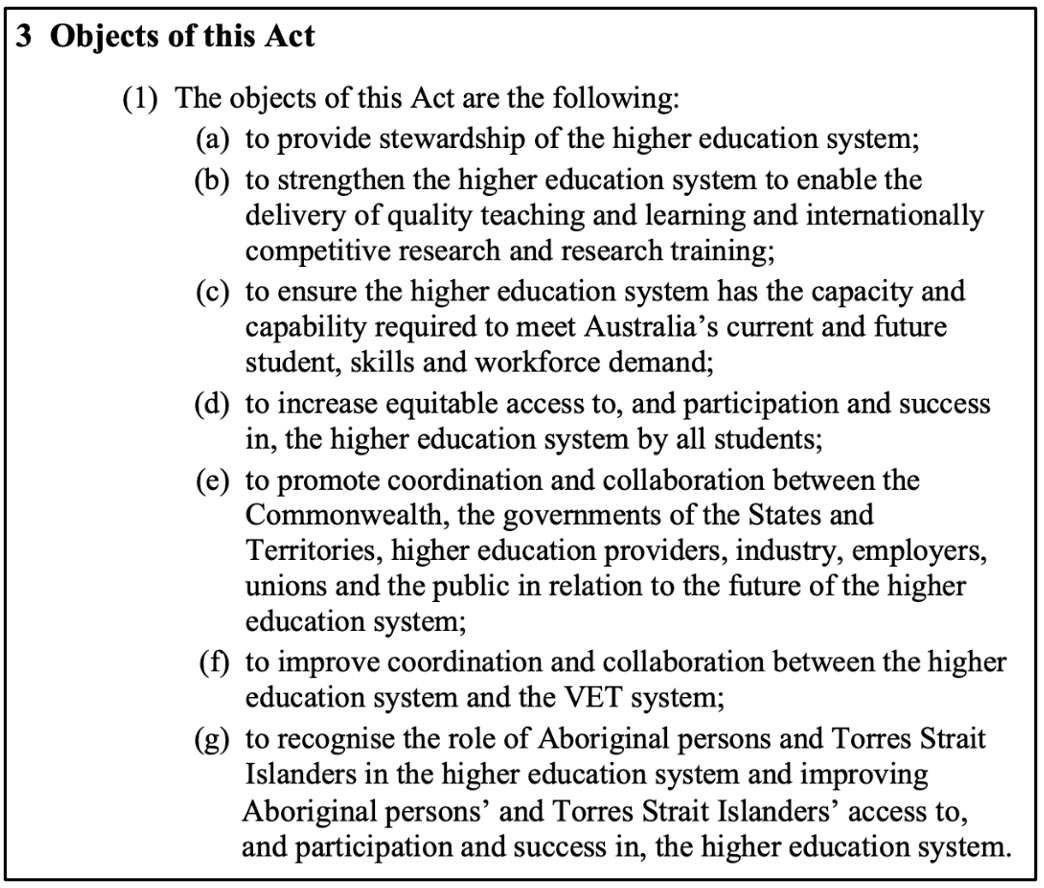
The Bill also includes the following requirements on ATEC – firstly the purpose of its legislation – note specifically 3(c) and (d):
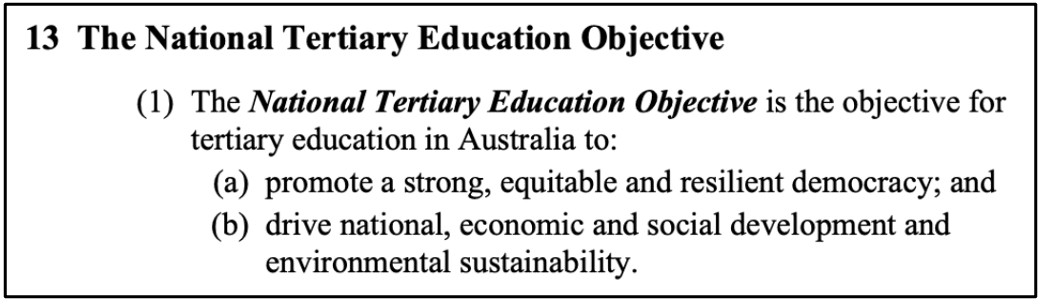
There’s also an objective for the tertiary education sector in the Bill – including “drive national, economic and social development.”
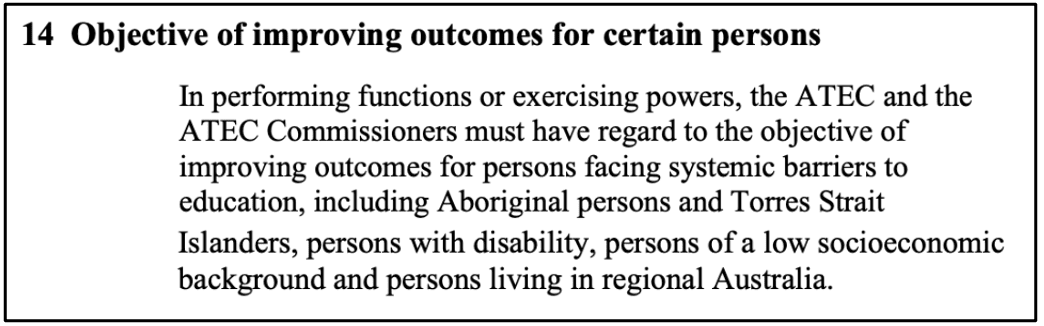
And ATEC must also explicitly be focussed on “the objective of improving outcomes for persons facing systemic barriers to education.”
I also think it’s worth keeping in mind that the legislation says that in its annual report ATEC can write about:
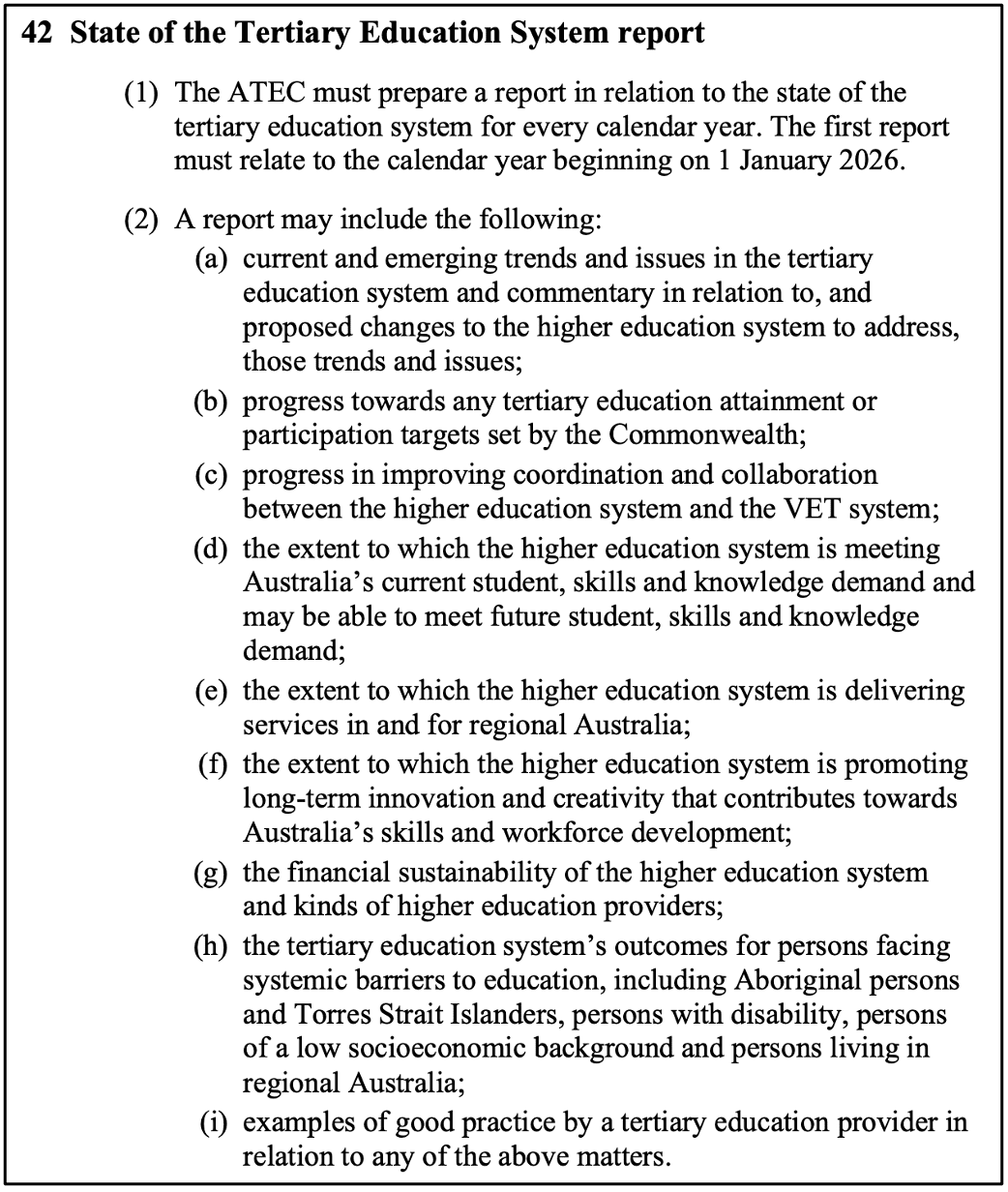
So as Commissioners sit down each year to write their annual report they are required in their legislation to be focussed on the sector’s capacity (ie what it is delivering with the funding it currently receives, where it can do more, etc), increasing equitable access and participation, driving Australia’s development, and improving outcomes for people from underrepresented groups.
I therefore think ATEC Commissioners will have to address Sections 42 (2)(a), (d), (g) and (h) of their legislation in their annual reports, ie I don’t think ATEC can write an annual report on the ‘State of the Sector’ which ignores issues of:
- the sector’s financial sustainability
- how many students are enrolling – especially from different equity groups, and
- how well positioned the sector is for meeting current and future demands for skills and knowledge.
That said – I do think the Bill could be improved by:
- specifying that ATEC can give the Minister advice on student contributions
- clarifying if TAFE Institutes and any other providers which are allocated Commonwealth Supported Places funding must enter into mission-based funding compacts with ATEC (and if not, how ATEC will engage with them)
- allowing ATEC to hire staff from outside government agencies where it has a specific need (eg experts working in universities, peak bodies, etc who may have expertise not available within the public service), and
- allowing ATEC to issue its own reports, consistent with its legislation, where it thinks there is a public interest – without needing the Minister to request the report.