Posts

A tale of two regulators…
A tale of two regulators… (update 14 December 2025 re: correspondence between TEQSA and the ANU)


TEQSA

The last few weeks has seen Australia’s higher education regulator, the Tertiary Education Quality and Standards Agency (TEQSA) flex its muscles in its compliance assessment of the Australian National University (ANU).

In an appearance before the Senate Education and Employment Legislation Committee inquiry into the “Quality of governance at Australian higher education providers” in late November, the CEO of TEQSA, Dr Mary Russell, was asked by Senator David Pocock whether TEQSA’s “existing remit and powers are adequate to address issues in cases where there have been gross failures of leadership or serious allegations raised against senior university leadership. Do you have the tools to be able to deal with that?”

She replied:

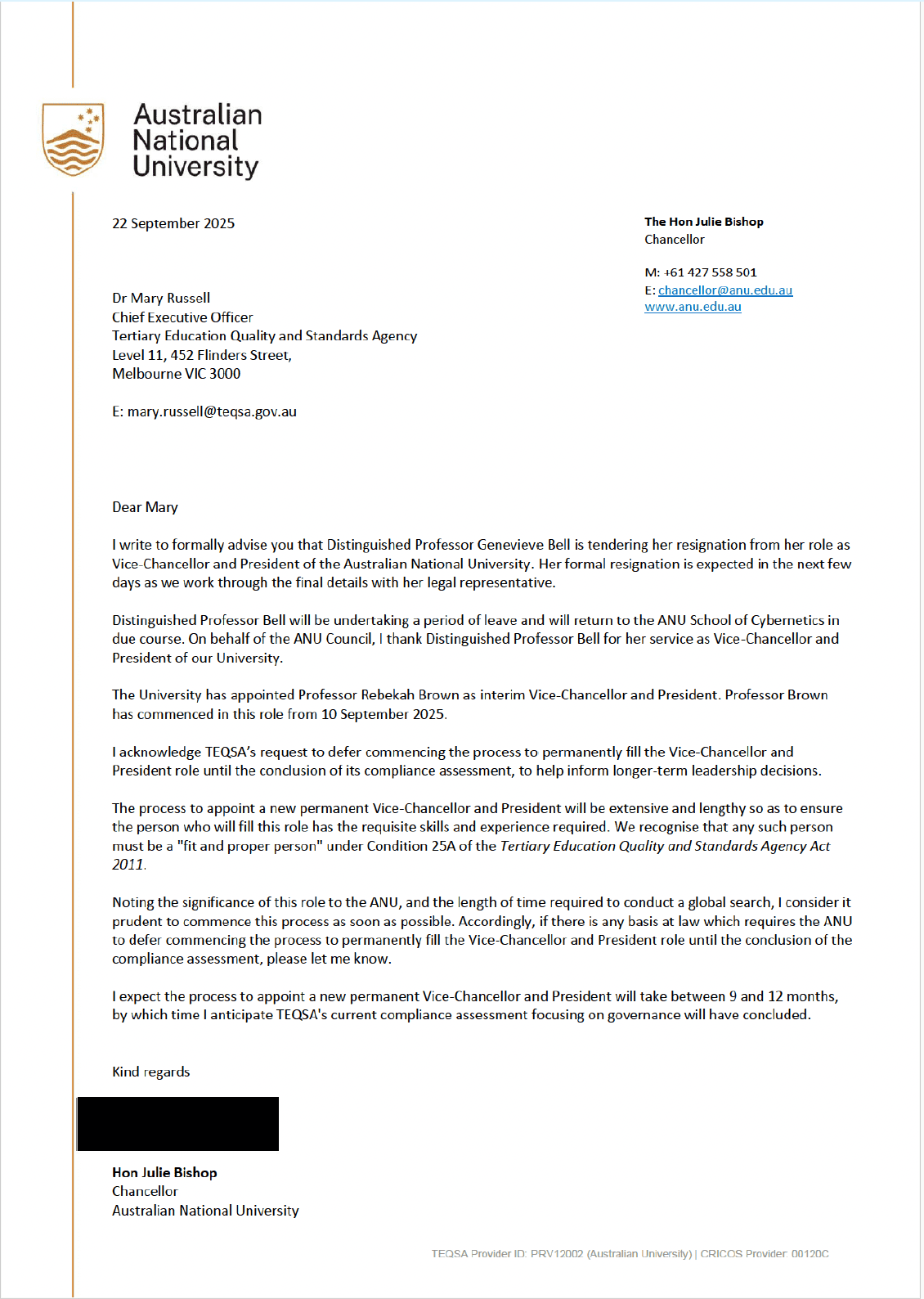
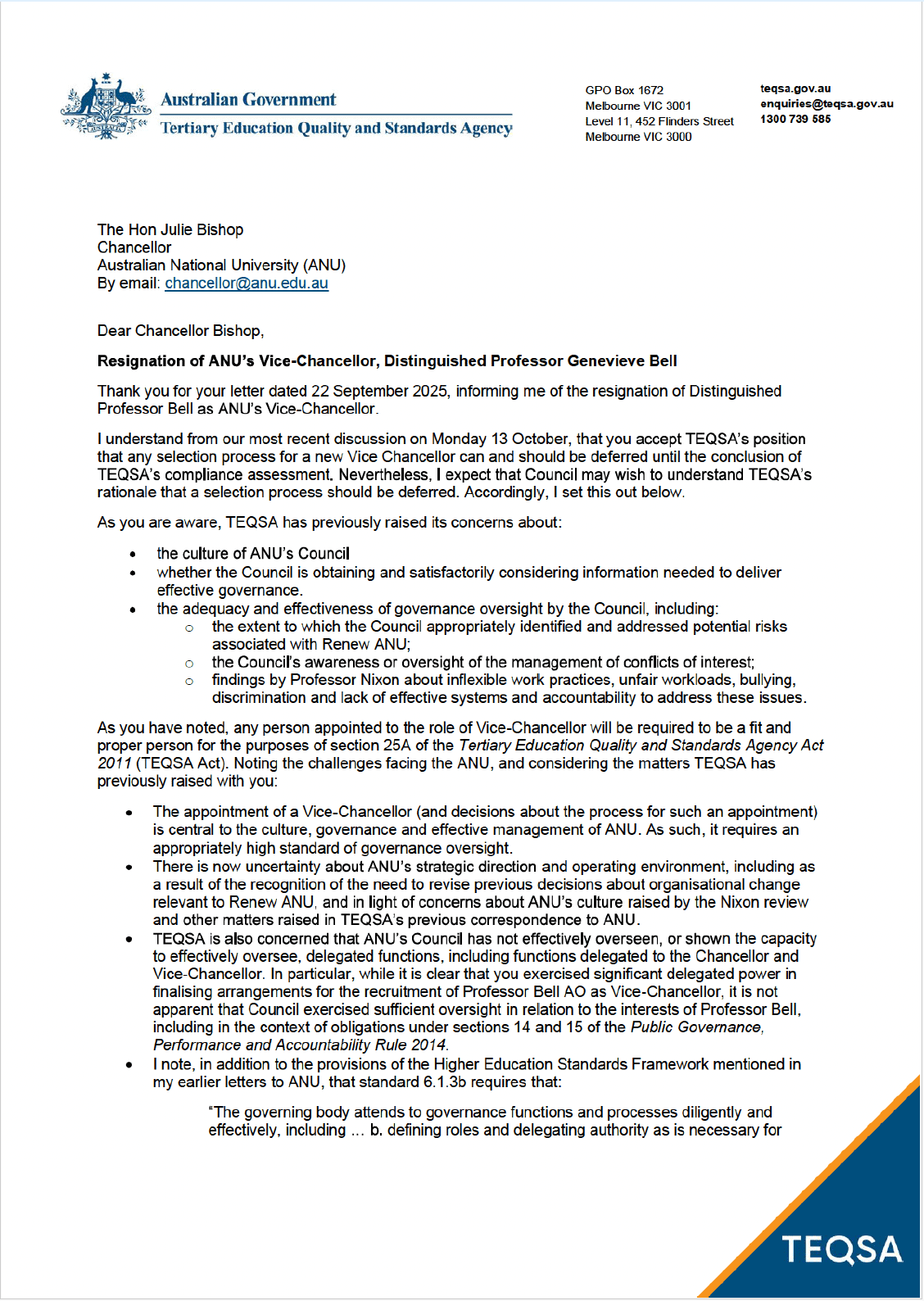
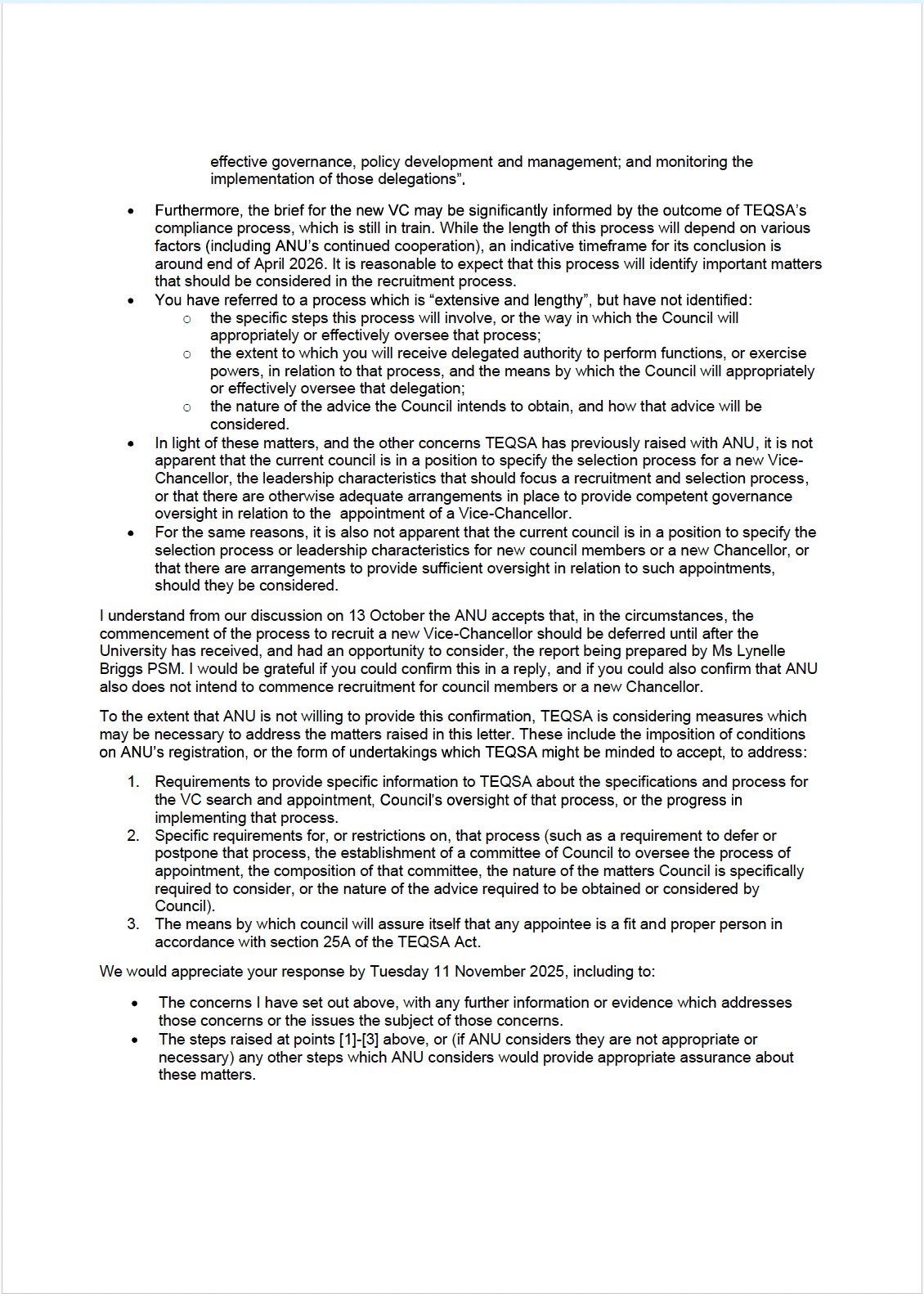
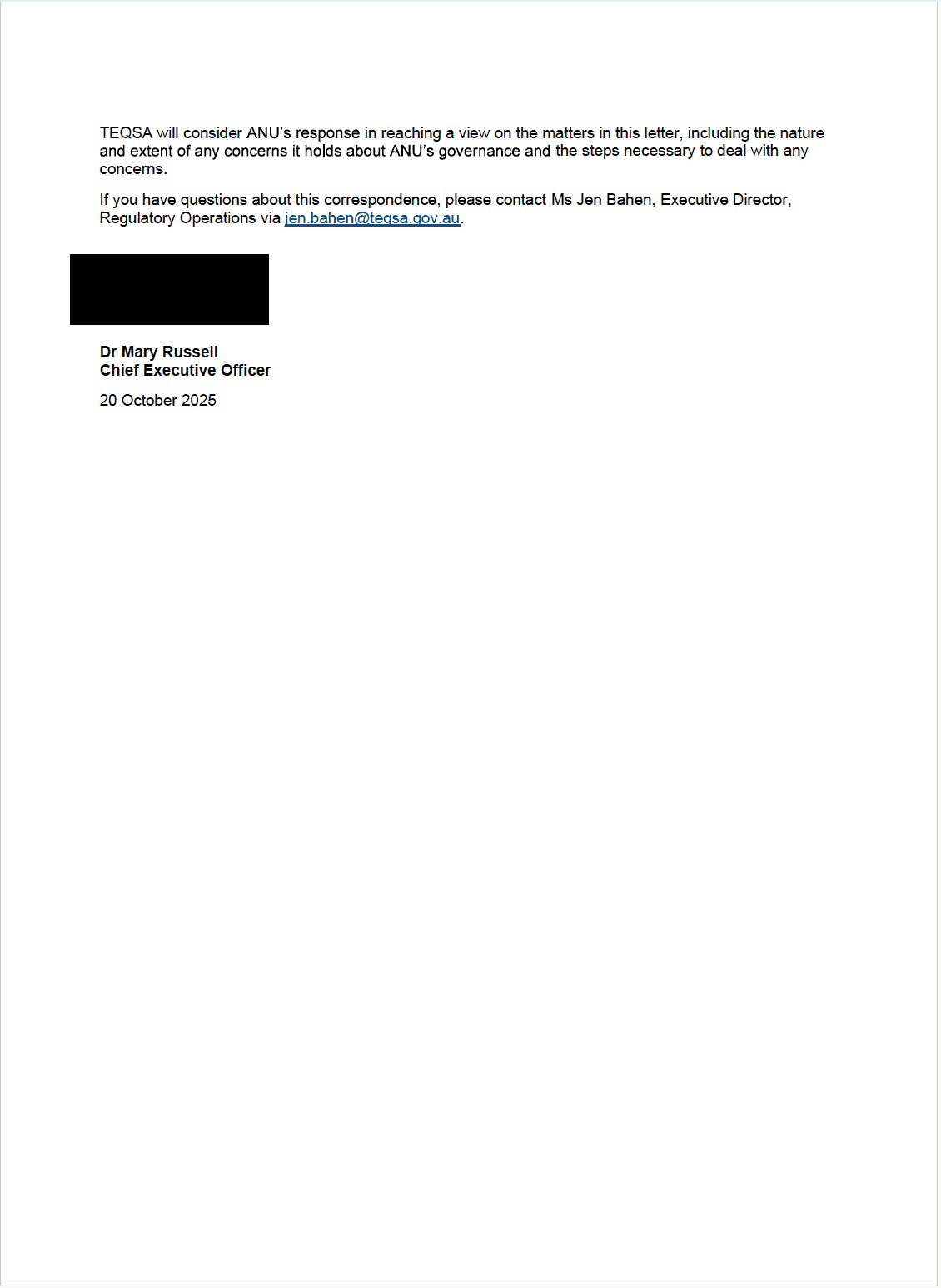
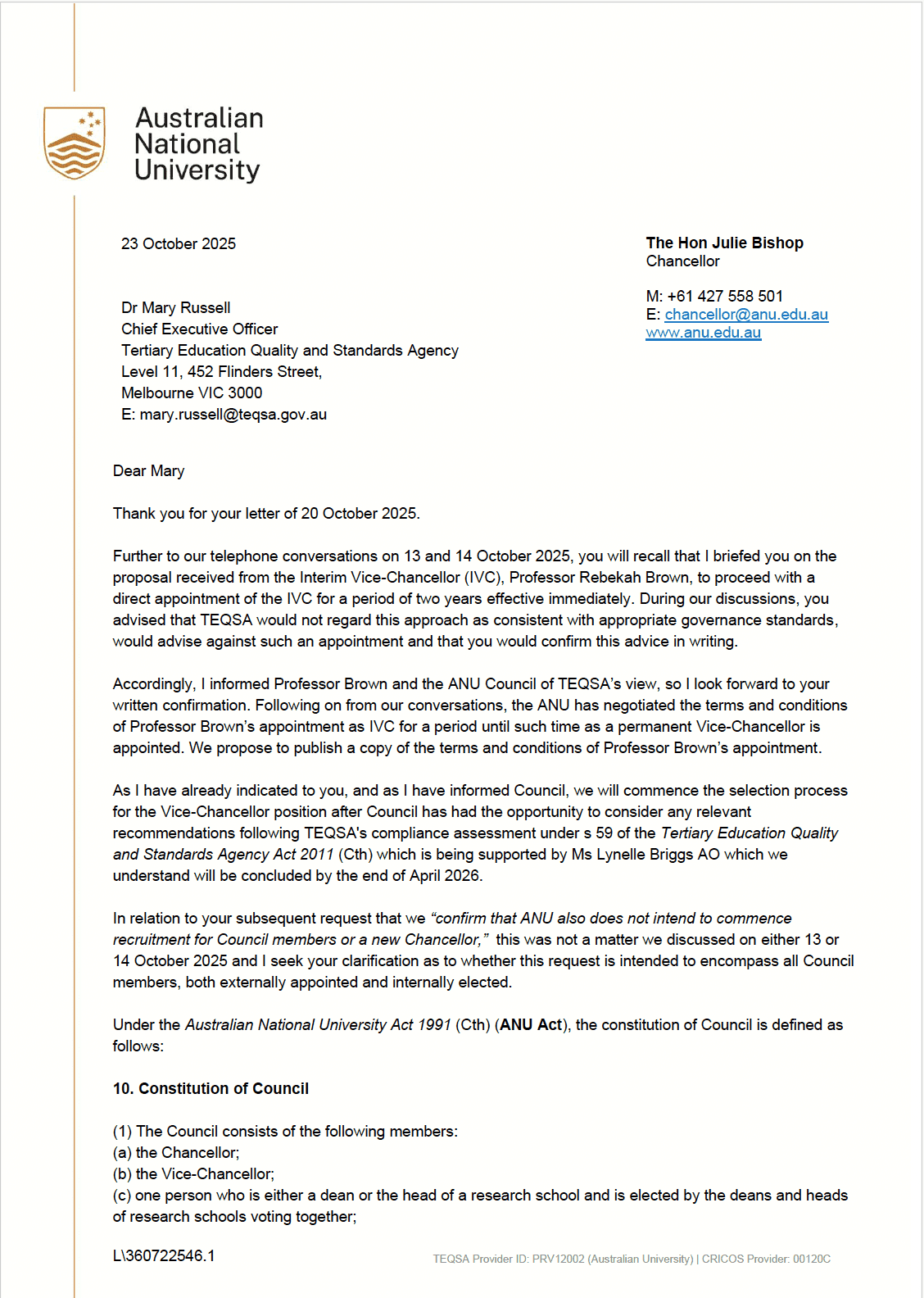
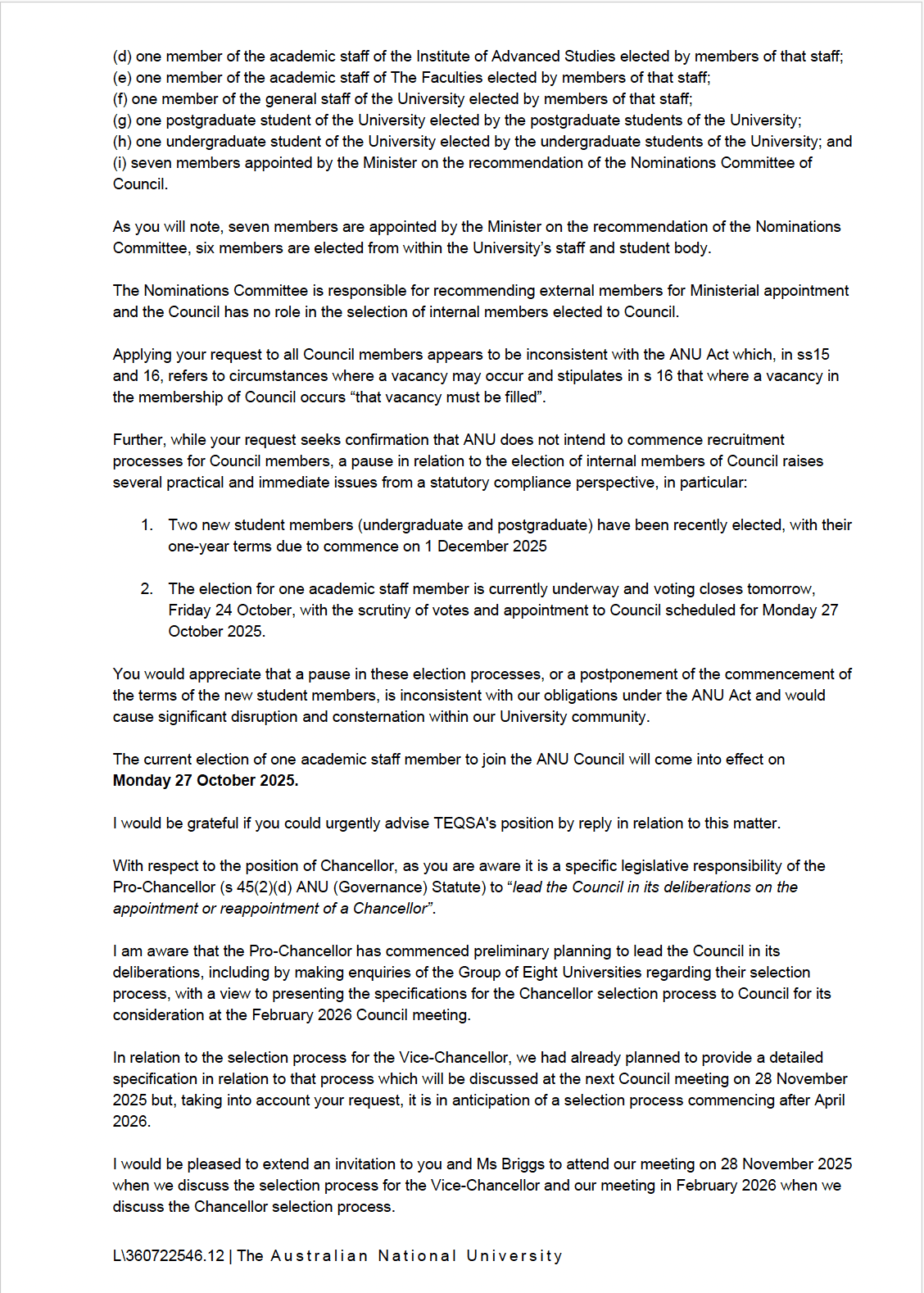
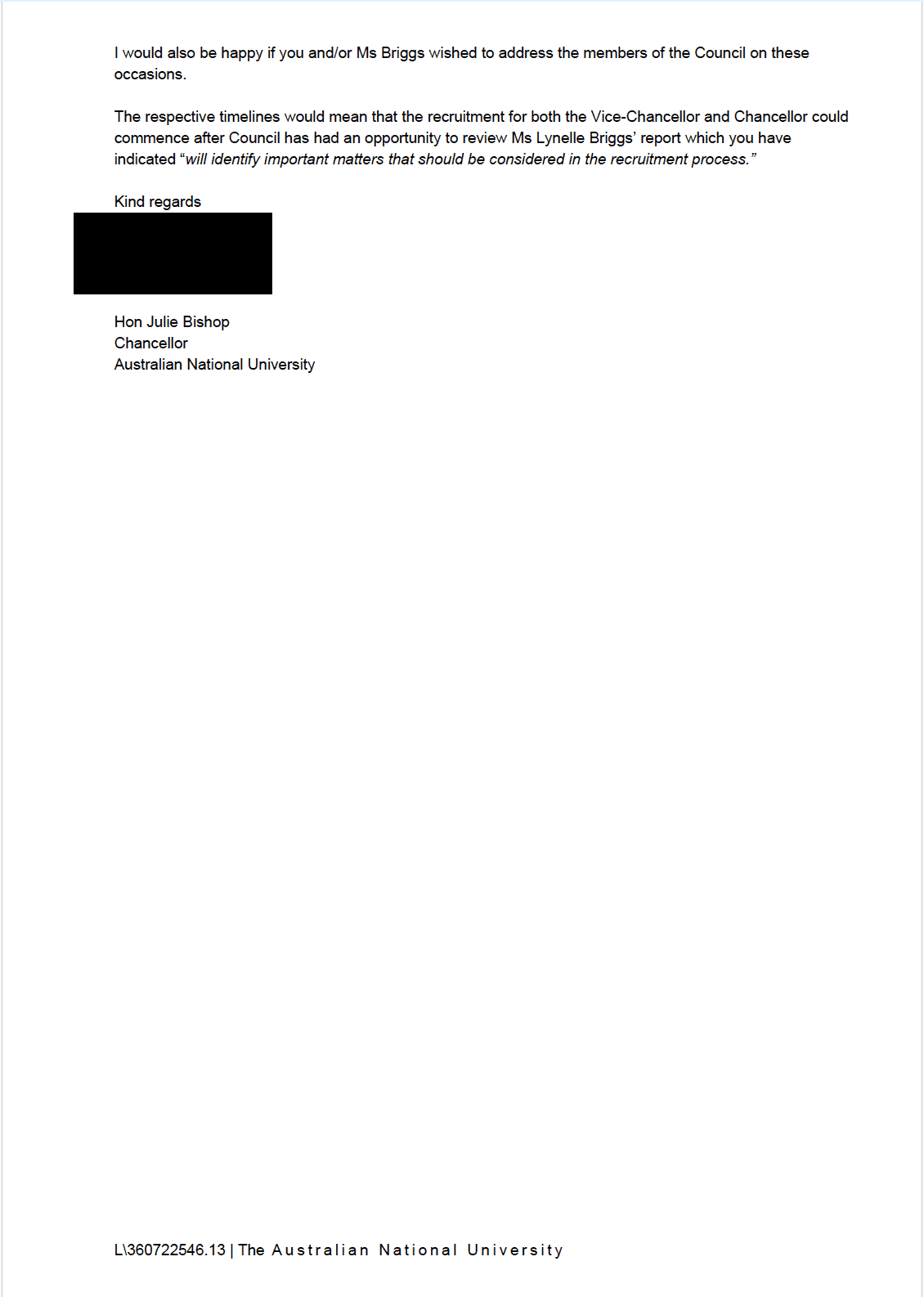
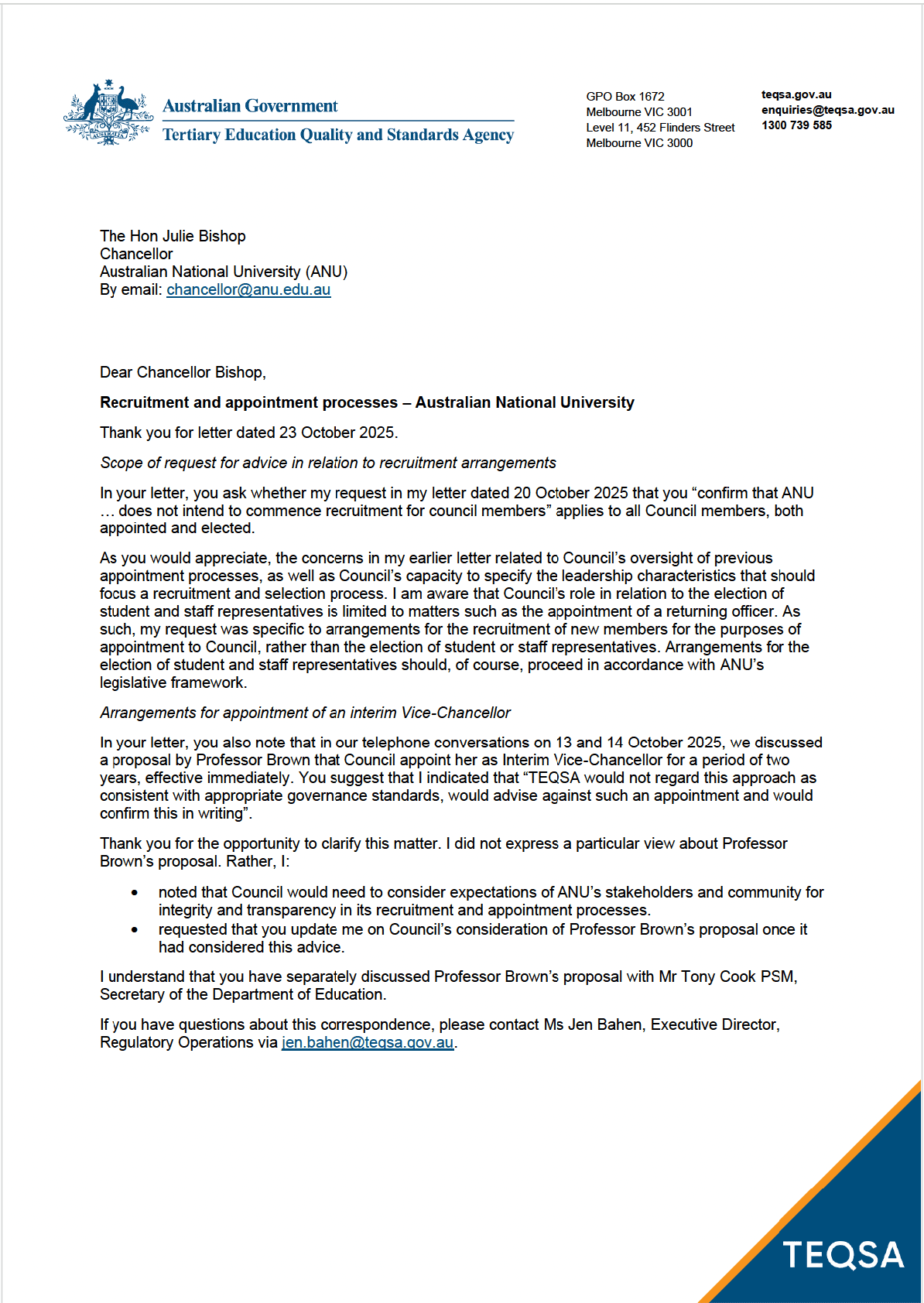
TEQSA provided a copy of Dr Russell’s correspondence with the ANU in answer to a question on notice (and hence while it is not available on the Senate website in the ‘tabled documents’ section – it is available in Answer to Question on Notice: SQ25-000637). There are a lot of questions and answers so to make it easier to read the correspondence – I have included the relevant letters between the ANU Chancellor and TEQSA CEO at the end of this update.

What was confirmed last week in Senate Estimates is that TEQSA has won the “stand-off” with the ANU Council: a new Vice Chancellor of the university will not be appointed until TEQSA’s work is done, and TEQSA’s work will also impact the Council’s decisions and timing in appointing a new Chancellor – potentially seeing the Council setting up an independent committee to manage the recruitment process for the next Chancellor – a process TEQSA “would be willing to work with them” on.

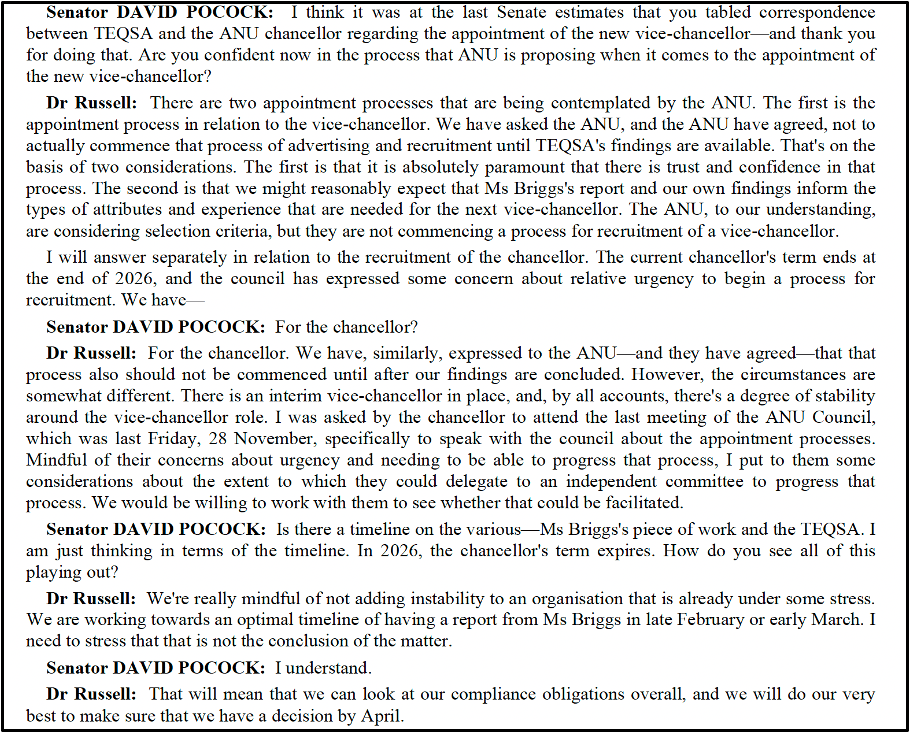
Here is the relevant extract in full from the 4 December Senate Estimates hearing:
 

Summary

The decision by the ANU Council not to proceed with recruitment of a new VC until TEQSA’s compliance assessment is concluded is appropriate.  

Similarly, given TEQSA’s compliance assessment is so heavily focussed on the university’s governance, the Council should be working with TEQSA in forming an independent committee to lead the recruitment work for the new Chancellor.

Of course these are major changes to ‘business as usual’ in university governance and they may well be seen by some in the sector as interfering with university autonomy.

The reality is, as the Convenor of the University Chancellor’s Committee Prof. John Pollaers pointed out recently at the annual TEQSA conference, university autonomy historically related to academic freedom, not to freedom from appropriate organisational regulation.

The decision by the ANU Council is a sign they understand the serious potential consequences of TEQSA’s compliance assessment, and the need for a new approach to leadership at the university.

ASQA

Things have been quite different for Australia’s VET regulator, the Australian Skills Quality Authority (ASQA) which suffered a defeat in the Administrative Review Tribunal on 1 December 2025, with the decision published last week.

Worryingly, details in the ART decision point to what appear to be problems in ASQA’s decision making and potentially its conduct as a ‘model litigant’.

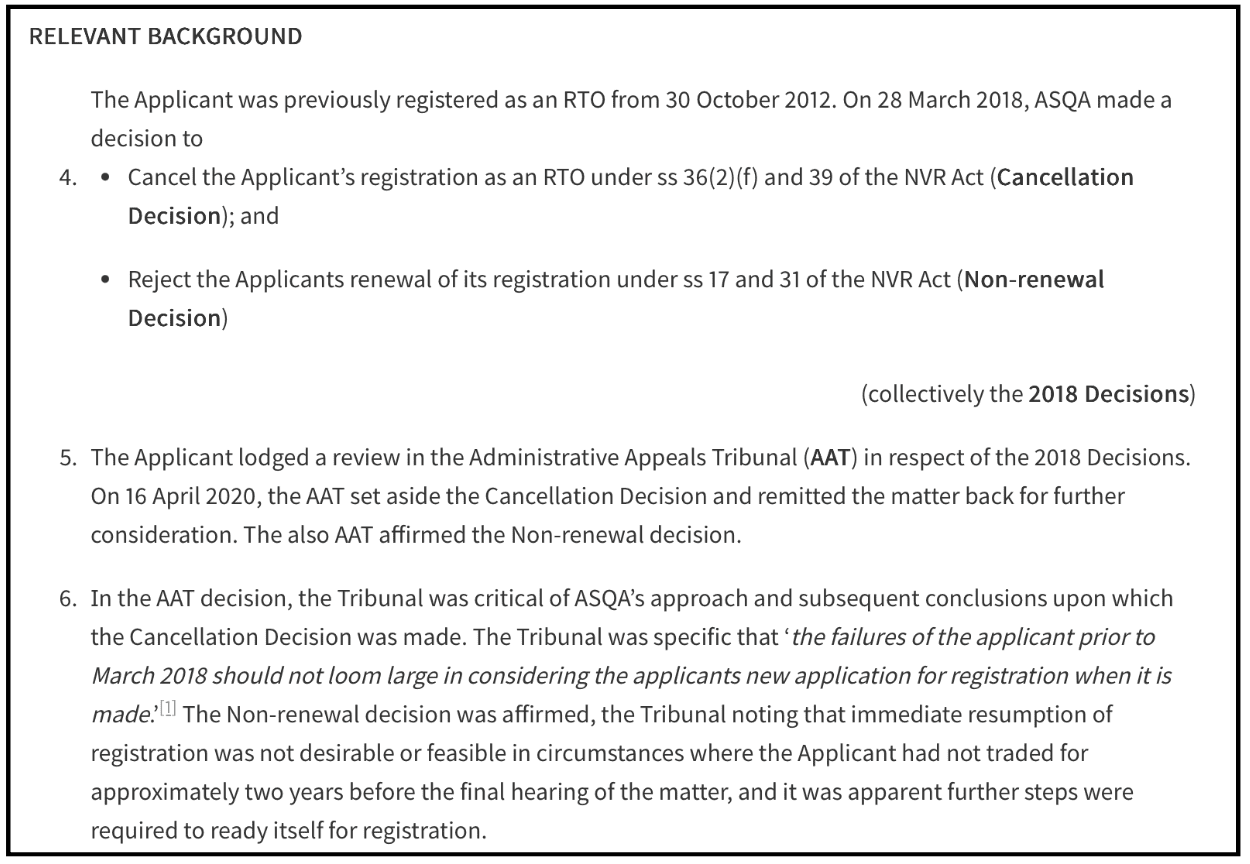
This decision relates to the case of Trades College Australia Pty Ltd (Trades College) which had its registration cancelled by ASQA in 2018, and unusually in 2024 they then lodged a new application for initial registration for the same organisation.

Here is the background to that matter, note that the Tribunal member hearing the most recent case states that “the Tribunal was critical of ASQA ‘s approach and subsequent conclusions upon which the Cancellation Decision was made” but because Trades College had not been operating for two years during the appeal process and because some of the qualifications it offered had gone through changes during the appeal process – the decision was taken that they should re-apply for initial registration rather than continuing to operate:
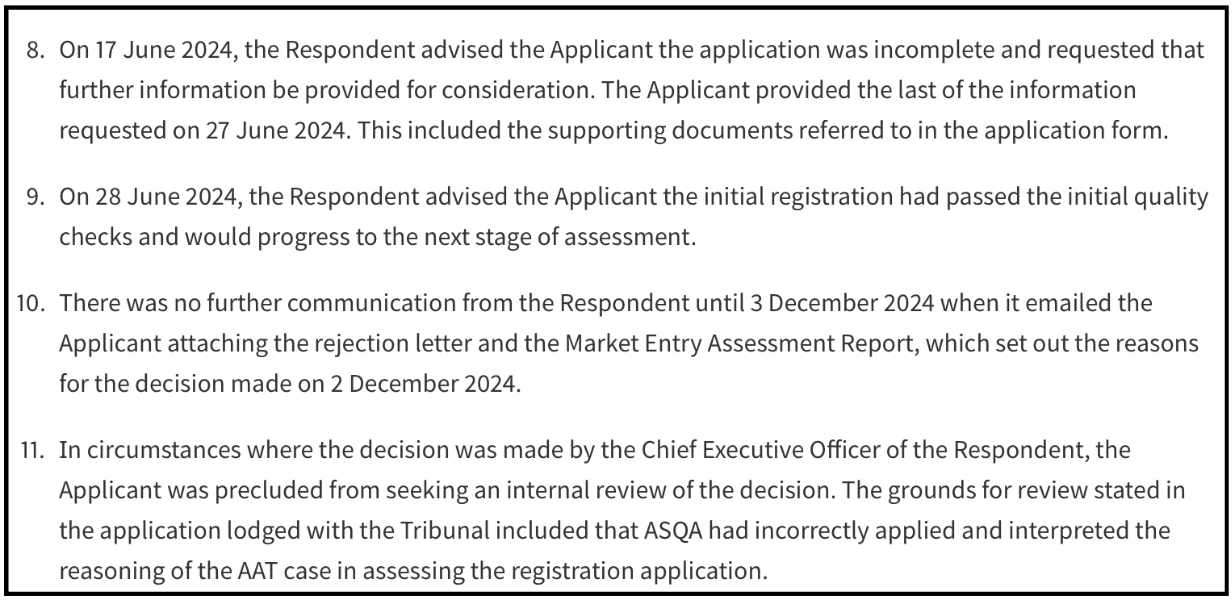
Subsequently Trades College submitted their new application, ASQA received it and said it was moving to the next stage of assessment – in June 2024. It appears that then had no contact with Trades College until December 2024 when they rejected their application and because ASQA’s CEO made the decision to reject the application, Trades College had no recourse to to seek an internal review of the rejection decision. Instead their only option was this ART appeal:
The matter then proceeded through the ART processes. Trades College provided their evidence in late June 2025. It appears ASQA chose not to lodge any further evidence/documentation. Instead they emailed the ART saying they intended to negotiate with Trades College to take the matter out of the hands of the ART and return it to ASQA for an internal review:
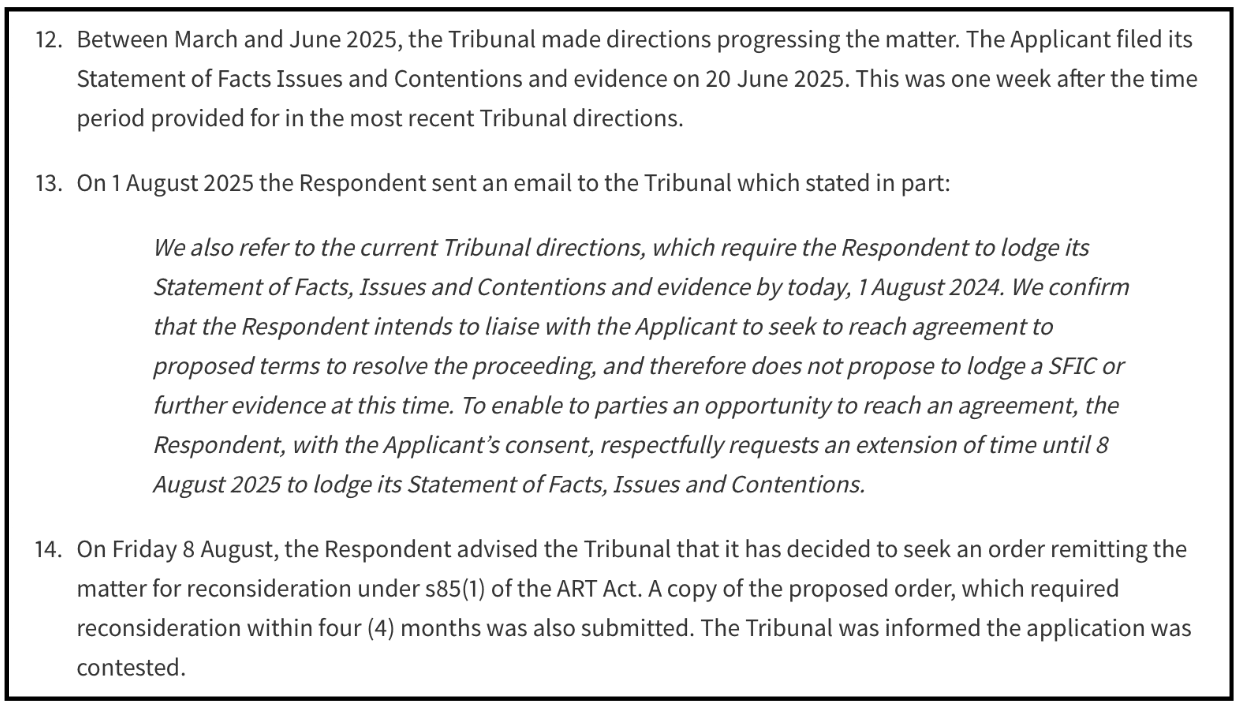
Perhaps unsurprisingly Trades College indicated they would prefer the matter to continue to be dealt with in the ART, so the issue the Tribunal was considering in this current case, was whether they should they agree to ASQA’s request that they should take back the decision on Trades College’s compliance and review it themselves (ie take it out of the ART):
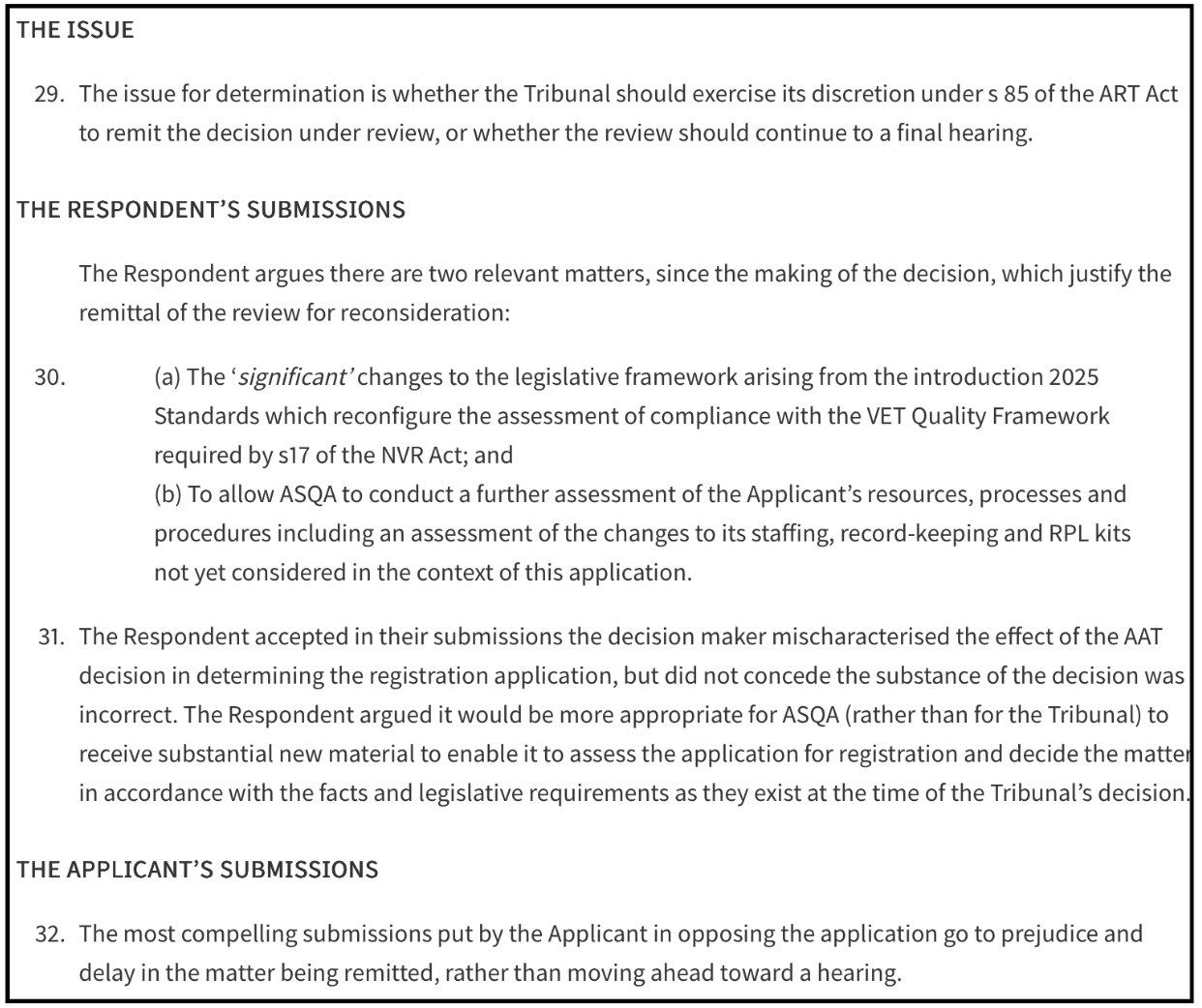
The ART decided in favour of continuing the appeal, ie not to allow ASQA to take the decision back:

While ASQA has published media releases about their two recent wins in the ART (where the Tribunal agreed with ASQA’s decision to cancel students’ qualifications – albeit if the providers the students studied with successfully appeal the decisions to cancel their RTO registration then the students’ qualifications can be reinstated) – they do not seem to have issued media releases about this or other recent losses in the ART.

The most recent appeal by a student of an ASQA qualification cancellation decision was successful (ie the student won and has not had her qualification cancelled).

And, while it is hard to find the record on the training.gov.au website,  the high profile cancellation decision ASQA took against Entry Education was also set aside (rejected) by the ART. (Go to: https://training.gov.au/organisation/details/41529/summary, scroll down to ‘Regulatory decision history’, and open either of the pdfs).


Summary

ASQA is to be supported in its endeavours to clean up the fraud and poor practice in the VET sector – but in doing so it needs to ensure that its risk assessment methods are well targeted and that its internal practices are robust and defensible.

In the interests of greater transparency it would also be good to see ASQA publish media releases about all of the decisions issued by the ART, so that the sector can better understand its successes and failures in the ART.


Correspondence between TEQSA and the ANU
How well are ASQA’s efforts to improve integrity in the VET sector working out?

How well are ASQA’s efforts to improve integrity in the VET sector working out?

Not that well at the moment – based on the evidence.

When you look at where ASQA has been focussing its attention in the last 18 months it would be fair to say that the integrity issues identified in the Nixon Review appear largely unaddressed (at least in terms of any public actions) and the public actions ASQA has taken on integrity issues seem very poorly focussed.

Here are some of what has me concerned:

  1. Why was ASQA focussed on discussing 23,000 cancelled VET qualifications (issued by 10 cancelled RTOs) at a recent international education agent conference… when only one of the 10 RTOs was CRICOS approved to deliver education to international students… and when the qualifications issued by that provider to their international students have not been found to have integrity issues and thus have not been cancelled?

The providers in question are listed on ASQA’s website: https://www.asqa.gov.au/students/qualification-integrity-regulatory-action

Only one of them had CRICOS approval and, as the Koala News reported, ASQA did not cancel any of the qualifications issued by this provider to their international students. Instead apparently finding they had been properly taught and assessed.

Despite this lack of evidence of any need to cancel the qualifications of any international students – ASQA thought it a productive use of their Executive Director – Integrity’s time to present to an audience of predominantly education agents at the SYMPLED2025 conference on ASQA’s efforts to cancel the qualifications of nine domestic RTOs and the domestic students of a CRICOS RTO.

I wasn’t at the conference but thanks to Rob McGowan from Torrens University’s write up (again in Koala News) we learn that, along with the Director of the Tuition Protection Service, ASQA’s representative:

“…delivered a sobering session on the rise of non-genuine providers and bad-faith operators. With over 23,000 qualifications voided due to college closures, the sector faces serious threats – from fraudulent issuance and phoenixing to criminal infiltration.

“Systemic problem requires a systematic solution.” It was recognised that these unethical and sometimes unlawful actions are resulting from a small minority but undermine the integrity of the sector and are being addressed.”

Clearly a powerful message – but totally misdirected given none of the public actions ASQA has taken to cancel qualifications so far relate to international students.


2. In separate regulatory action by ASQA – related to its concerns about academic integrity (contract cheating and undetected use by students of GenAI) – ASQA has just lost its case in the Administrative Review Tribunal.

In February this year the Sydney Morning Herald reported on ASQA’s attempts to cancel the registration of:

“One of the country’s largest training colleges has been ordered to shut down amid allegations that it failed to prevent students cheating, as part of an aggressive crackdown by the vocational education watchdog to clean up the sector.”

The provider, Entry Education, provided the SMH journalist with details of ASQA’s audit findings:

“The authority’s report said there was “significant concern” over the college’s use of online assessments, and it believed students had used AI to complete work, pointing to an example which it said appeared “too perfect” and showed indications of being an AI-generated response.”

Entry Education spoke to the journalist at the SMH and published their own statement on their website. They also challenged the decision in the Administrative Review Tribunal (ART).

Subsequently, in its April 2025 ASQA IQ update newsletter, ASQA published a range of statements about academic integrity, contract cheating and students’ potential use of GenAI. That was their first advice to the providers they regulate on this important integrity issue – despite the fact it appears to have been one of the reasons they were seeking to cancel Entry Education’s registration.

I am not aware of any further advice provided by ASQA to the sector (in webinars, statements of regulatory intent, etc) in the last six months on this critical academic integrity matter.

Last week Entry Education’s listing on the training.gov.au website was updated. When you get to the page, you need to turn on RTO history – yes, and scroll to the bottom of the summary page. There you will find two ‘details’ buttons showing the two related actions by ASQA that Entry Education was appealing (cancellation and a condition that they not enrol new students) had both been ‘set aside’ by the ART – that is, the Tribunal found in favour of Entry Education and threw out ASQA’s cancellation and conditions decisions.

3. In July I published data from the training.gov.au website showing 1 in 10 RTOs and 1 in 7 CRICOS providers are run by CEOs who use generic emails (like gmail and yahoo) to run their businesses. Despite this being a known integrity risk in the sector for 15 years it is unclear if any action has been taken by ASQA.

How much confidence would you have in someone like honey123@gmail.com running a college your son or daughter wanted to study at?

Does that kind of business practice scream “integrity?”

Clearly it does not – so why does ASQA find it acceptable to use these kinds of email addresses, for years and years, to engage with the providers they regulate? Especially after the work the VRQA did during the first international student crisis which first showed that the use of generic email addresses like these are a proven integrity risk.

4. This time last year, with the help of a few colleagues with eagle eyes, I disproved claims that ASQA’s efforts to ‘lapse’ the registration of 150 providers was a major win for integrity.

Claims were made at the time that ASQA’s efforts were cleaning up a:

“decade-long mess, shutting down ‘dormant’ registered training providers (RTOs) who have failed to show proof of delivering training for 12 months or more.

The Australian Skills Quality Authority (ASQA) is keeping an eye on an additional 140 RTOs who have received a warning notice. They must resume quality training by the end of 2024 or face deregistration. Those who don’t resume satisfactory training will be found out and action will be taken to shut them down.

Improving integrity in the VET system means students are better placed to study at quality providers while employers can trust qualifications. This saves businesses time and money by improving the hiring process – and ensures students aren’t exploited.”

After I shone a light on the fact that so many of the ‘lapsed’ or ‘dormant’ providers were not involved in dubious practices but had merely not enrolled students for a while (eg Ausgrid as an enterprise RTO, numerous Catholic schools, etc), the report on lapsed providers, which had been published on the training.gov.au website, was removed.

That report on ‘lapsed’ providers has now been replaced by new reports available on the training.gov.au website, where lapsed providers are now simply a subset of those with ‘non-current’ registration, making it generally more difficult to monitor ASQA’s “integrity” actions with respect to these RTOs.

It is not clear from the brief summary details on the ASQA representative’s comments to the SYMPLED2025 conference – if actions against this group of providers was included in ASQA’s claims about the success of its regulatory activities to clean up integrity issues. Based on my analysis last year, if any actions against lapsed providers were being publicly portrayed as integrity measures against a group that was uniformly delivering unsatisfactory training warranting action to “shut them down” it would be untruthful.

So where does that leave us in terms of the regulator’s efforts to strengthen integrity in the sector?

  • Cancelled qualifications – 10 RTOs (a number of whom are challenging the cancellation decision in the ART), nine of which are domestic and one with CRICOS approval but no international students have had their qualifications cancelled – despite the Nixon Review shining a light on abhorrent practices in a portion of the international VET sector.
  • Academic integrity – one ASQA IQ update newsletter published with some dot points on the issue – but more significantly – one RTO cancellation decision on this issue thrown out by the ART.
  • CEOs using generic email addresses – no publicly visible action on this known integrity issue by ASQA.
  • Lapsed providers – any actions ASQA has taken since its first efforts 12 months ago are now less visible to the public – and the significance of its initial actions were overstated.

Unpacking the 2026 student visa caps

VET’s real integrity risk

Problems with the pilot of the Revised Standards for RTOs

The Productivity Commission takes a look at VET